
blog
The Sun, Spacetime, and the Order of Creation
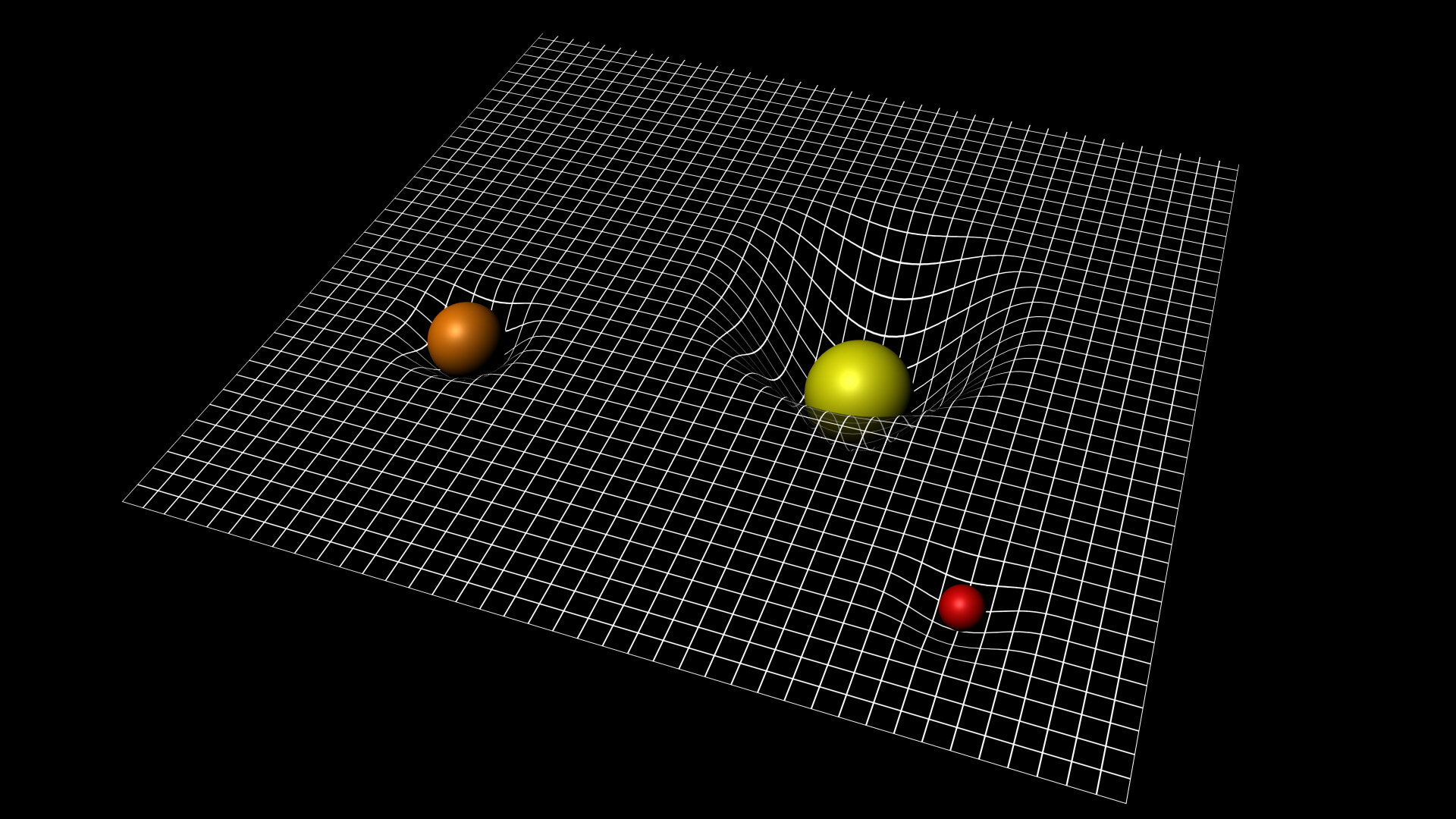
Most of us grow up with a simple picture of gravity: the Sun pulls the Earth.
Newton gave us a remarkably powerful way to describe this attraction:
In this equation, F is the gravitational force between two objects, G is the gravitational constant, M and m are the objects’ masses, and r is the distance between their centers. The larger either mass becomes, the stronger the attraction. But distance has an even more dramatic effect: because it is squared, doubling the distance makes the gravitational force four times weaker.
For everyday calculations, planetary motion, engineering, and countless other problems, Newtonian gravity works extraordinarily well. But there is a deeper question hiding behind the equation: what does it actually mean for one object to “pull” another through empty space?
Newton could describe the strength of gravity with incredible accuracy, but the deeper nature of gravity remained mysterious.
Centuries later, Albert Einstein changed the question itself.
Instead of asking how strongly the Sun pulls the Earth, Einstein’s General Theory of Relativity invites us to ask something more fundamental: what does the presence of the Sun do to space and time around it?
In General Relativity, gravity is not merely treated as an invisible force acting across empty space. Mass and energy change the geometry of spacetime. The Sun, because of its enormous mass, curves the spacetime around it, and the Earth moves through that curved geometry.
A famous summary by physicist John Archibald Wheeler captures the idea beautifully:
Matter tells spacetime how to curve, and spacetime tells matter how to move.
This means that the Earth is not simply being dragged through space by an invisible cosmic rope. It is following the natural path available to it inside a curved spacetime.
One of the strangest consequences of this idea is that the Earth is, in a sense, constantly falling.
It never stops.
The Earth has a large sideways velocity while the Sun curves the spacetime around it. As the Earth moves forward, its path continuously bends around the Sun. This is what we call an orbit.
An orbit is not the absence of falling.
An orbit is falling continuously without ever reaching the object you are falling toward.
Newton imagined something similar with his famous cannonball thought experiment. Imagine firing a cannonball horizontally from a very high mountain. If it moves slowly, it falls back to Earth. If it moves faster, it lands farther away. If it could move fast enough, the surface of the Earth would curve away beneath it at the same rate that the cannonball falls.
The cannonball would keep falling, but it would never hit the ground.
It would orbit the Earth.
Our planet is doing something similar around the Sun.
In Newtonian physics, saying that the Sun pulls the Earth is perfectly useful. It is not simply “wrong.” But General Relativity gives us a deeper description.
The Earth follows what physicists call a geodesic: the closest equivalent to a straight-line path inside curved spacetime. What looks to us like a curved orbit is, from the perspective of spacetime geometry, the Earth following its natural path.
The picture changes from:
Sun → gravitational force → Earth
to something closer to:
Sun → curved spacetime → Earth follows the geometry
The distinction may sound philosophical at first, but it produces measurable consequences. General Relativity explains phenomena that Newtonian gravity cannot fully describe, including gravitational time dilation, gravitational lensing, the orbit of Mercury, black holes, and gravitational waves.
And the strange behavior of gravity is not limited to planets and stars. It affects us every moment.
Consider someone standing on the ground. We normally say that gravity is pulling them downward. But in General Relativity, someone in free fall is actually following a natural geodesic through spacetime.
Someone standing on the ground is different.
The ground prevents them from following that free-fall path. The floor continuously pushes upward against their body.
This is why astronauts in orbit experience weightlessness. It is not because gravity has disappeared. Gravity at the altitude of the International Space Station is still significant. The astronauts, the station, and everything inside it are falling together around the Earth. They are all following nearly the same path through spacetime.
Einstein’s theory becomes even stranger when we remember that gravity does not only affect space.
It affects time.
Clocks in stronger gravitational fields run slightly slower than clocks in weaker gravitational fields. This phenomenon is called gravitational time dilation.
It may sound like science fiction, but it has practical consequences. Modern satellite navigation systems must account for relativistic effects. Without those corrections, positioning errors would accumulate.
Gravity is therefore not merely about objects falling. It is connected to the structure of space, motion, and time itself.
Our intuition often imagines the universe as a giant empty stage. Space is the stage; planets, stars, and galaxies are the actors.
General Relativity destroys this simple picture.
The stage itself can change.
Spacetime can curve. It can stretch. It can carry waves. Massive objects can reshape its geometry. Two black holes can collide and send ripples through spacetime itself.
We call those ripples gravitational waves.
The universe is not merely a collection of objects moving inside space. The structure of space and time participates in the story.
And yet, when we look at the Solar System, everything appears calm.
The Sun rises. The Moon moves across the sky. The planets return to predictable positions.
But this apparent calm is built on extraordinary motion.
The Earth travels around the Sun at roughly 30 kilometers per second. The Sun moves around the center of the Milky Way. The Milky Way itself moves through the cosmos.
Nothing is truly standing still.
And yet there is order.
This gives us an interesting idea: order does not require stillness.
Cosmic order can emerge through motion governed by consistent laws. The planets remain in their paths not because the universe is motionless, but because motion itself follows structure.
This is where scientific curiosity can meet an Islamic perspective.
The goal should not be to claim that the Qur’an is a physics textbook, or that modern scientific theories were secretly encoded in scripture. Such claims often oversimplify both science and revelation.
A more meaningful approach is to consider the Islamic concept of ayah.
The word ayah can mean a verse, but it also means a sign.
The Qur’an repeatedly invites human beings to observe the heavens, the Earth, the alternation of night and day, the Sun, the Moon, and the order of creation. The invitation is not simply to look.
It is to think.
To reflect.
To notice.
To contemplate.

In the Islamic tradition, tafakkur refers to deep reflection and contemplation. One of the most powerful examples appears in Surah Ali ‘Imran, verses 190–191, where the creation of the heavens and the Earth and the alternation of night and day are described as signs for people of understanding.
The interesting part is the relationship between observation and reflection.
The cosmos is not presented merely as decoration.
It becomes something to think about.
Science can tell us more and more about how the universe behaves. It can describe orbits, stars, spacetime, black holes, and gravitational waves.
Faith introduces another kind of question:
What should our understanding of this order do to us?
The questions are different, but they do not need to be enemies.
Consider an impossible thought experiment.
Suppose the Sun suddenly vanished.
Would the Earth instantly fly away from its orbit?
No.
Information about changes in gravity does not travel infinitely fast. Changes in the gravitational field propagate at the speed of light.
Light from the Sun takes approximately eight minutes and twenty seconds to reach Earth. A change in the Sun’s gravitational influence would also require time to reach us.
For those minutes, the Earth would continue moving according to the spacetime geometry it had already experienced.
This is one of the reasons gravity is more profound than the old picture of instantaneous attraction. Gravity is part of a universe where causality has a speed limit.
Black holes make this picture even more extreme.
They are often described as cosmic vacuum cleaners, but that description is misleading. A black hole is better understood as an extreme consequence of spacetime curvature.
When enough mass-energy becomes concentrated into a sufficiently small region, the geometry of spacetime becomes so extreme that an event horizon forms. Beyond that horizon, all future-directed paths lead inward.
The same theory that describes the Earth orbiting the Sun also describes black holes.
The difference is not that black holes possess a completely different kind of gravity.
It is the degree to which spacetime is curved.
The scale of the universe itself is almost impossible to imagine.
Earth is only about 12,742 kilometers in diameter. The Sun is roughly 1.39 million kilometers across. The Milky Way spans around 100,000 light-years. The observable universe extends tens of billions of light-years in every direction.
On that scale, human beings seem physically insignificant.
And yet something remarkable happens.
Tiny creatures on a small planet can look at the sky, construct mathematics, build instruments, and discover rules describing stars, galaxies, and spacetime itself.
There is humility in that realization.
But there is also wonder.
Perhaps one of the deepest questions is not simply:
How does the universe work?
But:
Why is the universe understandable at all?
Why can mathematical structures created by human minds describe the behavior of distant planets, collapsing stars, or ripples in spacetime?
Science continues to investigate the patterns. It tests them, refines them, and sometimes replaces old models with deeper ones.
From an Islamic perspective, the existence of intelligible order can itself become an object of contemplation.
Not as a shortcut to scientific proof.
But as a reason to reflect on creation with greater attention.
Tomorrow morning, the Sun may rise exactly as expected.
Most of us will barely notice it.
We will wake up. Drink coffee. Go to work. Check our phones. Continue with ordinary life.
But beneath that ordinary experience, something extraordinary is happening.
The Earth is moving around the Sun at tens of kilometers per second. The Sun is shaping the geometry of spacetime around it. The Earth is following that geometry.
We are moving with it.
Quietly.
Continuously.
Without feeling the cosmic motion beneath our feet.
Perhaps the more interesting question is not why the Earth does not fall into the Sun.
Perhaps the deeper realization is this:
It has been falling all along.
And perhaps tafakkur begins at exactly that moment, when something we have seen every day suddenly stops looking ordinary.


